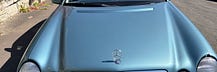
The Credential
A story about the Mercedes-Benz SmartKey

There is a box on the console table in my hall. It is made from conductive mesh, a Faraday cage. I bought it for my previous two cars: a W206 Mercedes and, before that, a Renault Megane I won’t dwell on. Both had keyless entry. Both broadcast a signal from wherever the key was sitting, and that signal could be cloned, amplified, relayed across a wall, and used to open and start the car while you slept. Terrifying. It happened to my brother-in-law’s beautiful Alfa Romeo Giulia. I went on Amazon the next day and the box was the answer to that. Key goes in the box. Car stays outside the house.
I don’t need the box anymore.
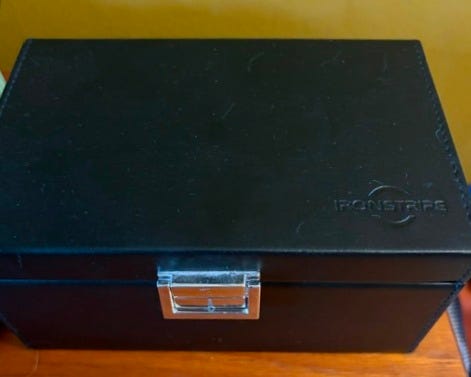
The SLK doesn’t have keyless entry. Neither does the W210, which replaced the W206. The box sits there anyway, because habits are easier to keep than to break, and because at some point it stopped being a security measure and became part of coming home. I put the keys in the box. This is what I do now.
Last week I took one out and looked at it properly. Held it, turned it over, tried to work out what it actually is.
It is not a key. Not in any sense that would have been recognised thirty years ago.
Black plastic. Red plastic nose like a TV remote control. Three buttons. Surprisingly light in the hand. Hidden inside is a removable emergency blade for getting into the door if the electronics fail. I have never used it. I expect I won’t.
The blade can open the door and lock the glovebox.
It cannot start the engine.
For that, the important part is invisible.
Mercedes called it the SmartKey. The engineering designation was FBS3, Fahrberechtigungssystem 3, Drive Authorisation System 3. Developed in the mid-1990s with Siemens Automotive and Huf, it entered production in 1997 and became one of the longest-lived pieces of security engineering the company ever produced.
When you push the key into the EIS, the Electronic Ignition Switch, the car inductively powers the electronics inside the key and begins an encrypted authentication process. The key and the car exchange coded information. If the response is valid, the ignition switch, the electronic steering lock and the engine management system reach a collective agreement that the vehicle is permitted to start. If the response is invalid, the process ends there.
No grinding starter.
No partial success.
No negotiation.
The car simply refuses.
Today this sounds entirely unremarkable. In 1997 it was not. It sounded like the future.
Most manufacturers at the time were adding electronic security to traditional ignition systems. Transponder chips, immobilisers, remote locking: increasingly standard, increasingly expected. But the underlying architecture stayed familiar. A metal key entered a mechanical ignition barrel and physically operated the starting system. The lock was still the lock.
Mercedes approached the problem differently.
Rather than improving the lock, they reduced its importance.
The ignition barrel ceased to be a meaningful security device. Authorisation became an electronic process involving multiple control units communicating with each other before the car would permit itself to start. The key was no longer a shaped piece of metal that the car trusted because it fitted. It became part of a distributed security system.
A W124 key is a satisfying mechanical object: tight tolerances, proper metal, a quality of manufacture you can feel in the turn. The SmartKey looks cheaper and is considerably harder to defeat. That is not a coincidence.
FBS3 first appeared on late W202 C-Class and W210 E-Class models and spread from there across the whole range, eventually securing everything from a basic four-cylinder A-Class to a twin-turbo V12 Maybach. It ran for almost two decades. The key housings changed. The frequencies changed. The processors got faster. The underlying architecture stayed because the original concept was solid enough to support whatever came next.
This was how Mercedes engineered during that period. The company was systematically replacing mechanical processes with electronic ones. Stability control. CAN-bus networking. Radar cruise control. Integrated navigation. FBS3 belonged to the same movement. It was not designed merely to solve the theft problems of 1997. It was designed as a platform for the technologies that would follow. The fact that it survived as long as it did suggests they got the foundations right.
The irony is that success produced its own complications.
A worn ignition barrel can often be sorted by an auto locksmith for an amount of money that does not require a conversation with yourself. An ageing FBS3 system is different. Ignition switches fail. Steering lock modules fail. Keys fail. Diagnosis requires specialist equipment and a trip to a main dealer. The security that made the system so effective made it considerably more expensive to go wrong.
That is the bargain Mercedes made. They did not pretend otherwise.
The Faraday box on the console table is, on reflection, a monument to a problem that got solved and then, through a different kind of cleverness, made worse. The SmartKey answered the mechanical barrel’s vulnerability. Keyless entry answered the SmartKey’s friction. And then keyless entry turned out to be trivially defeated by two people with relay equipment and an interest in your car, which is how I ended up with a mesh box on my console table in the first place.
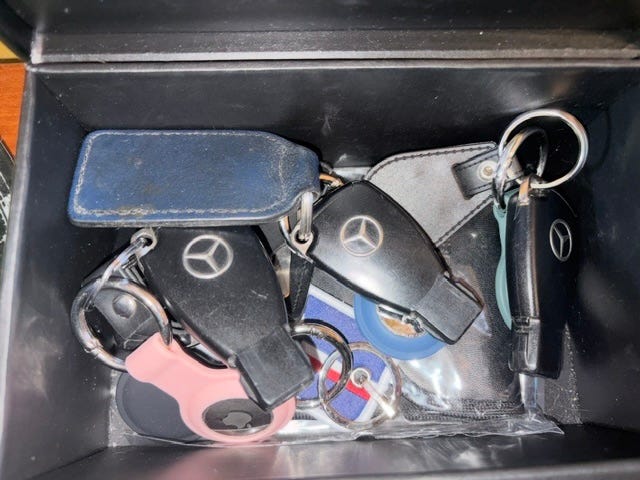
The key that requires you to insert it and turn it does not have this problem. It requires you to be present, with the correct credential in your hand. The car checks the answer and decides. It is slower. It demands a small deliberate act at the start of every journey.
There is, however, one flaw in the system, and it is not the rolling-code architecture.
I have four keys for two cars. All identical black plastic fish.
The box does not discriminate.
More than once I have walked to the wrong car, pressed the button, wondered why nothing happened, and stood on my own street looking faintly suspicious while the correct key sat in the house.
Twenty years of encrypted authentication. Four identical fobs. One idiot.